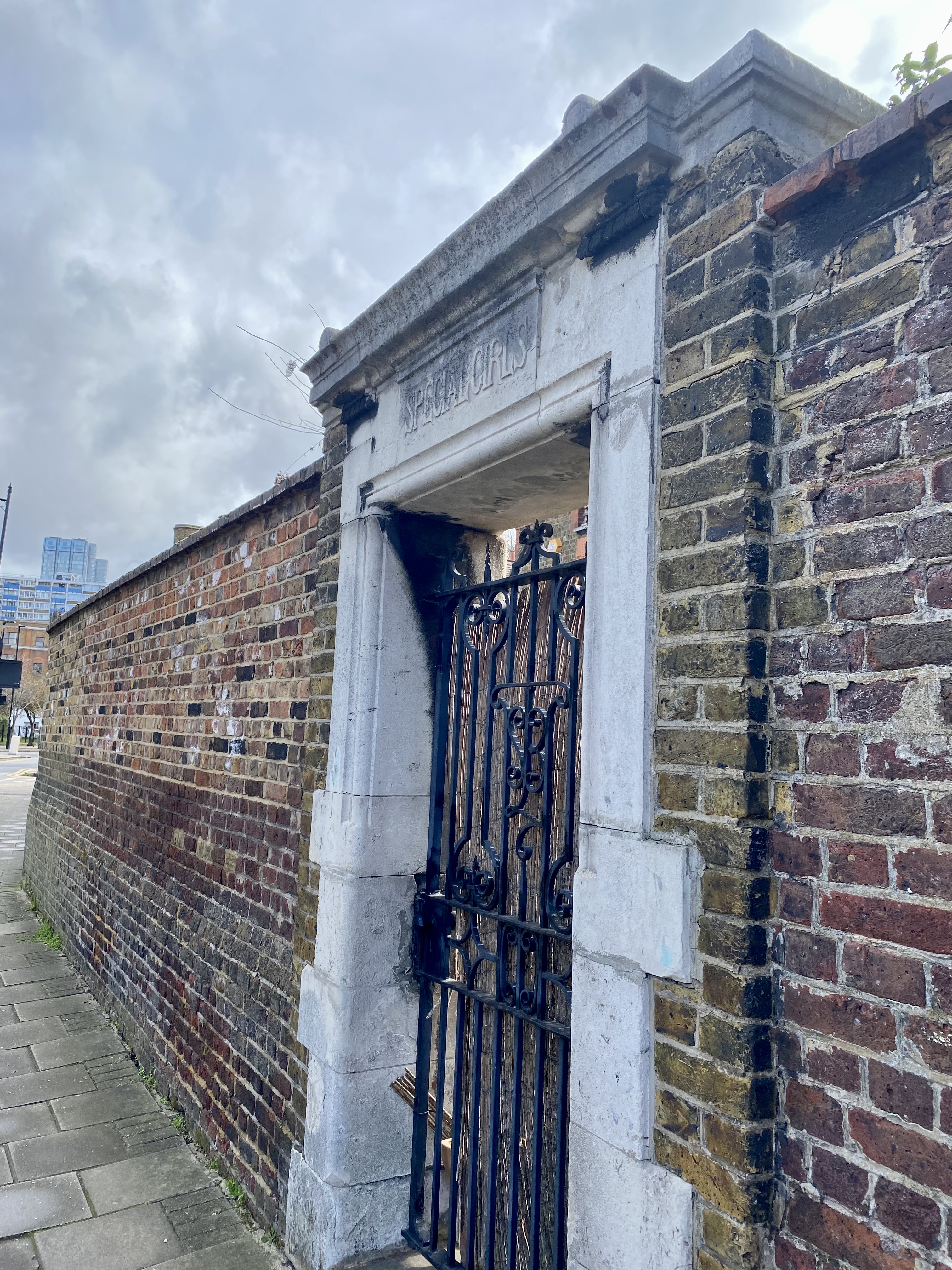
Image credit: No Swan So Fine / Wikimedia Commons · CC BY-SA 4.0 · 2022-03-31 ↗
Former House of Detention / Sans Walk cells
Clerkenwell · Clerkenwell · Second-audit addition
Story
On the unassuming Sans Walk in Clerkenwell, the memory of one of London’s most infamous penal institutions endures, albeit subtly. What today presents as a quiet residential setting was, for much of the 19th century, the site of the Clerkenwell House of Detention, a prison that became synonymous with the harsh carceral conditions of the Victorian era. Do not expect to find an intact prison, but the remnants of its brutal past are palpable to the discerning eye. This site was not Clerkenwell’s first prison. From the 17th century, the neighbourhood hosted a series of penal institutions, reflecting its role as an administrative and judicial hub for Middlesex. The original House of Detention, built in 1775, proved inadequate for the growing prisoner population and evolving ideas about penal reform. It was demolished, and in its place rose the much larger and imposing new House of Detention, opened in 1847. Designed by architect William Moseley, its formidable panopticon-style architecture – featuring a central watchtower – was intended to embody principles of discipline and control, a stark contrast to the smaller, chaotic Old Bridewell it replaced. The prison became tragically famous for the Fenian bomb plot of 1867, when an attempt to free two Irish prisoners by detonating a bomb against its outer wall resulted in twelve deaths and dozens of injuries among the public, alongside severe structural damage. This act of violence shocked the nation and highlighted the vulnerability of urban prisons. The building underwent several reconstructions after this event, but internal conditions remained severe, with small cells and a strict regime. Ultimately, the House of Detention was closed in 1877 and largely demolished to make way for the construction of the New River Head and other infrastructure. Yet, not everything disappeared. Fragments of its boundary walls, some underground passages, and even parts of the original cells have survived, repurposed as basements or integrated into the fabric of current buildings, particularly along Sans Walk. These remnants are a silent reminder of how Clerkenwell accumulated a remarkable concentration of courts, detention centres, and prisons, a legacy still traceable in its peculiar urban fabric today.
What to look for
Observe the layout of Sans Walk and the current residential fabric, noting the remarkable proximity of this site to the Old Sessions House and Clerkenwell Green.
Secret detail
Part of the site’s history survives below ground, but access to these remnants is not permanent and should not be assumed as possible.
Where exactly
Sans Walk, at the former House of Detention site.
Orientation
This is an exterior historical point of interest. There is no interior access unless an official opening is verified for that day.
Why it matters
This site completes Clerkenwell’s court-and-prison landscape, revealing the concentration of penal institutions in the neighbourhood during the 19th century.
Access & opening
Live verification required before production routing.
We never show live status. Check opening hours before you go.
Accessibility
Needs production accessibility check.